
There is no simple hierarchy of “better” or “worse” when it comes to flavor forms. Understanding your product base, production method, and application conditions is the key to selecting the right samples effectively.
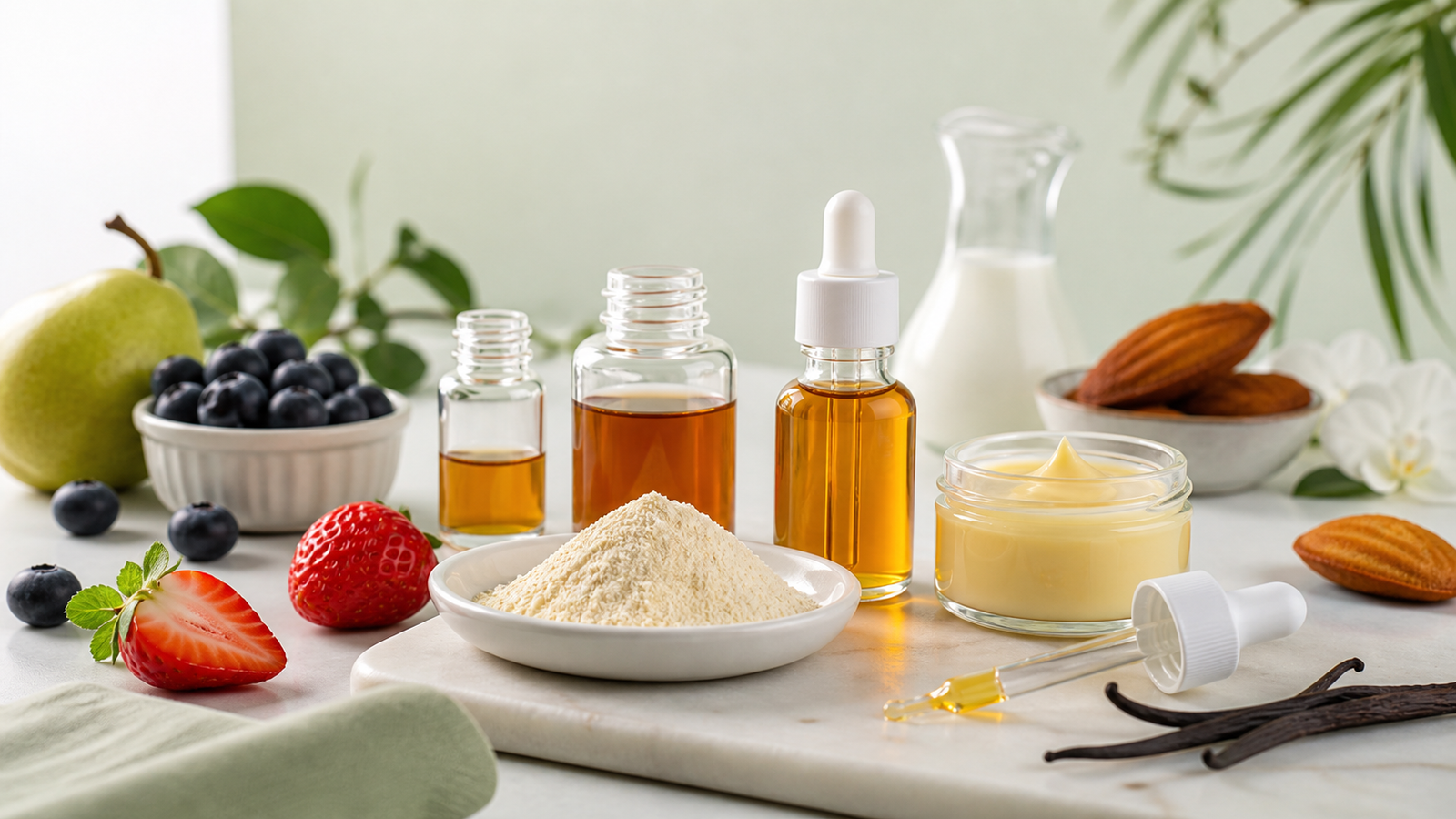
Introduction Common forms of food flavors include liquid, powder, and paste. Liquid products can be further classified by their dispersion or solubility characteristics. When selecting a flavor, do not rely solely on the flavor name. Instead, consider the food base, processing method, application technique, storage conditions, and supplier product specifications — and always confirm through actual product testing.
1. First, Distinguish “Flavor Profile” from “Flavor Form”
Flavor profile answers the question: “What taste should the product have?” — for example, dairy, fruit, nut, grain, or savory. Flavor form answers: “In what physical state is the flavor provided?” — commonly liquid, powder, or paste. These are two separate selection dimensions.
The same flavor may be available in different forms or for different applications. You cannot determine whether one product can directly replace another based on name alone. Actual selection should be based on specific product specifications, regulatory requirements, and sample testing results.
2. Characteristics of the Three Common Forms
Liquid flavors are easy to measure and mix. They may be further classified as water-soluble, oil-soluble, or dual-purpose (water and oil soluble). For beverages, dairy products, confectionery, bakery, and savory foods, dispersion and applicability should be confirmed based on the product base and processing method.
Powder flavors are easy to blend with other dry ingredients and are suitable for products requiring dry-state handling. Paste flavors have a thicker consistency and specific handling characteristics, and can be found in certain fillings, bakery products, or composite food applications. The above are general observations and do not imply that all products perform identically.
3. Five Key Points to Confirm When Selecting a Flavor
First, determine whether the product is water-based, oil-based, an emulsion system, or a dry powder. Second, identify whether the production process involves heating, baking, freezing, or prolonged mixing. Third, clarify when the flavor is added, how it is measured, and how it is dispersed. Fourth, specify the packaging and storage conditions of the finished product. Fifth, note the target sales market and applicable regulations.
This information helps suppliers narrow down the sample range. If the information is not yet complete, you can start by providing the product type, target flavor, and basic process, then refine the selection through small-scale trials.
4. Do Not Treat Form as a Quality Hierarchy
Liquid, powder, and paste forms are not ranked by quality. The right form is one that matches the target food system and production process, and achieves the desired sensory performance under compliant conditions.
Fenfang’s current product portfolio includes water-soluble liquids, dual-purpose (water and oil) liquids, oil-soluble liquids, confectionery-specific liquids, powders, and pastes. When requesting samples, we recommend submitting the food type, product base, and processing conditions so that both parties can discuss the selection based on specific product specifications.